The short version
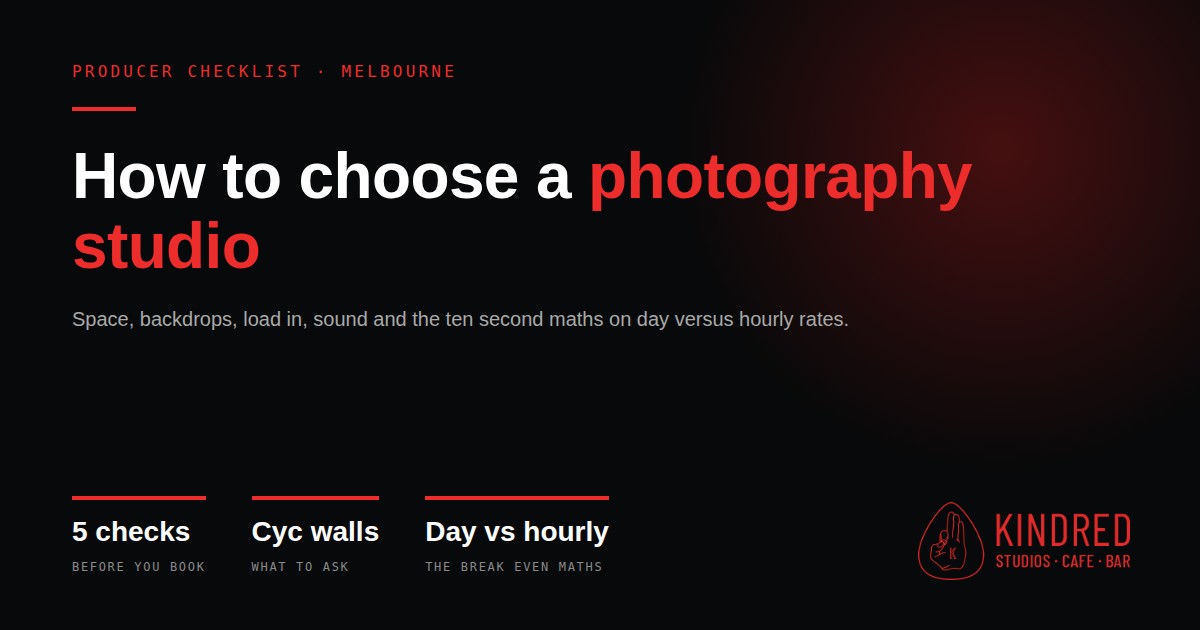
Choosing a photography or film studio in Melbourne comes down to five things: space, backdrop, load in, sound and how the rate is structured. Get those right and the shoot runs on time. Here is what to check before you book any studio:
- Floor size and ceiling height. Your set, your lights and your camera distance all have to fit. Ceiling height decides how high you can rig.
- Backdrop. Ask whether there is a cyc wall, what colour it is, and whether a fresh paint is included or charged.
- Load in. Ground level access and a door that opens to the outside save more time than any other feature on this list.
- Sound. If you are recording audio, ask what is booked in the rooms next door.
- Hourly or daily. Divide the day rate by the hourly rate to find your break even point, and count bump in and pack down in your hours.
- What comes with the room. Internet, a dressing room, furniture and flats are worth confirming before the day, not on it.
- See a worked example. Kindred Studios at 3 Harris St, Yarraville publishes its studio dimensions, inclusions and rates, so you can run this checklist against a real room.
The shoot is locked. Talent is booked, the client has signed off the moodboard, and the producer has one question left on the call sheet that has quietly become the most important: where are we actually doing this?
Studio listings all look the same in photos. A white wall, a softbox, a nice bit of window light. What decides whether the day runs on time is almost never in the photos. It is how far the van is from the door, whether the ceiling lets you get a light where you need it, and whether someone is about to start drumming on the other side of the wall.
Here is what to check before you hire a photography or film studio in Melbourne, from a creative complex in Yarraville that has been running since 2005.
How much space do you need in a photography studio?
More than the set. The set sits in the middle of the floor, but the camera needs distance from it, the lights need space around it, and the crew need somewhere to stand that is not in shot.
A rough way to think about it: a head and shoulders portrait works in a small room. A full length fashion shot needs the camera well back from the talent, so the long side of the floor matters. A product shoot on a table is forgiving. A small scene with two actors, a dolly and a boom operator is not.
Ceiling height is the number people forget. It decides how high you can put an overhead light, whether a boom can stay out of frame on a wide shot, and how far a light has to travel before it hits your subject. Low ceilings also bounce light back down where you may not want it.
For a sense of scale, Kindred’s studio in Yarraville has an 11 by 9 metre floor and a 4.4 metre ceiling. That is a room for a built set, not just a stool and a backdrop.
Cyc walls, backdrops and flats: what to ask about
A cyc wall, short for cyclorama, is a curved wall where the floor meets the back wall with no visible corner. It is what gives you that endless white or green background. If your shoot depends on one, ask directly: is there a cyc, how big is it, what colour is it, and is a repaint included or extra? Studios vary a lot on all four.
If there is no cyc, you are working with paper rolls, fabric or a built set. That is not a downside for a lot of work. Editorial, interview and music video shoots often look better against something with texture than against infinite white.
Flats are the other thing worth asking about. These are freestanding wall panels you can move around to build a corner, block light or create a quick set. Studios that include them save you a hire and a truck.
Load in, bump in and parking: the questions that save the day
Every hour of a studio booking you spend carrying cases is an hour you are paying for and not shooting. Before you book, ask:
- Where does the van park? On site parking means your gear is metres from the door, not around the block.
- Is the studio at ground level? Stairs and lifts turn a twenty minute bump in into an hour.
- Is there a door straight to the outside? External access means you are not rolling C stands through a café or a corridor of other tenants.
- Is bump in and out inside the booked time? Almost always yes. Build it into your hours from the start.
Recording sound in a shared creative building
If your shoot is stills only, skip this section. If you are recording dialogue, an interview or anything with clean audio, it matters.
Studios inside bigger creative buildings sit next to other rooms, and those rooms are being used. At Kindred, the film studio is next to other creative spaces, and depending on what is booked in the adjacent rooms there may be some slight noise spill. The fix is simple: tell us in advance that you have sound recording requirements, and we will look at the schedule around your booking.
It is worth asking the same question at any studio you are considering, because the answer tells you a lot about how the place is run.
Hourly or day rate: when does a full day work out cheaper?
Most studios in Melbourne offer both, and the maths takes ten seconds. Divide the day rate by the hourly rate. The answer is your break even point in hours. Book anything longer than that as a day.
Using Kindred’s published rates as a worked example: $484 a day divided by $66 an hour is 7.3. Seven hours at the hourly rate is $462 and eight hours is $528, so once a shoot runs past seven hours, the day rate is the cheaper option.
The trap is counting only the time the camera is rolling. Bump in, set up, lighting, talent changes and pack down all sit inside the booking. Plenty of shoots that look like a five hour job on paper become an eight hour day in practice, so if you are close to the line, book the day and stop watching the clock.
A short product shoot or a single headshot session sits comfortably on an hourly rate. Anything with a build, multiple setups or talent changes is usually a day.
How Kindred’s Yarraville studio answers the checklist
If you want to see how a real room stacks up, here is ours, item by item. Photos, full specs and current rates are on our page for photography and film studio hire in Melbourne.
- Space: an 11 by 9 metre floor with a 4.4 metre ceiling.
- Backdrop: flats and white furniture come with the hire. Ask about backdrop options when you enquire.
- Load in: on site parking, ground level access and external access for bump in.
- Sound: slight noise spill is possible depending on what is booked next door, so flag audio when you book.
- Rate: hourly or full day, with the break even at seven hours.
- In the room: NBN internet, AV patch bays, a dressing room and an on air light.
The building around it is part of the appeal. The studio sits inside a working creative complex at 3 Harris St, Yarraville, alongside private studio suites for photographers, designers, illustrators and makers, band rehearsal rooms and the Kindred Bandroom. Bass Note Café is on site from 8am to 2pm for the morning coffee run, and members of our coworking space get discounted rates on studio hire.
The film studio is booked directly rather than online. Email info@kindredstudios.com.au with your production details and preferred date, or call (03) 9689 9859.
Choosing a photography studio: FAQs
What should you look for when hiring a photography studio?
Check five things before you book a photography or film studio: floor size and ceiling height against your widest shot, what backdrop is available, how far the parking is from the studio door, whether sound carries from neighbouring rooms, and whether the hourly or day rate works out cheaper once bump in and pack down are counted.
What is a cyc wall in a photography studio?
A cyc wall, short for cyclorama, is a curved wall where the floor meets the back wall with no visible corner, which creates a seamless white or green background. If your shoot needs one, ask the studio about its size, its colour and whether a repaint is included in the hire or charged separately.
How much space do you need for a photo shoot?
Plan for your widest shot, not the set itself. Head and shoulders portraits and tabletop product work suit a small room. Full length fashion shots and small scenes need enough floor length for camera distance, plus space around the set for lights and crew. Ceiling height matters too, because it limits how high you can rig lights and keep a boom out of frame.
When is a studio day rate cheaper than the hourly rate?
Divide the day rate by the hourly rate to find the break even point in hours. At Kindred Studios in Yarraville, $484 a day divided by $66 an hour is 7.3, so any booking longer than seven hours is cheaper on the day rate. Count bump in, set up and pack down in your hours.
Is bump in counted in studio hire time?
Plan on bump in and pack down sitting inside your booked hours, and confirm it with the studio before you book. Ground level access, an external door and on site parking all shorten bump in, which means more of the booking goes on shooting.
Can you record sound in a studio inside a shared creative building?
Usually, with notice. Studios inside creative complexes sit next to rooms that are in use. At Kindred Studios, depending on what is booked in the adjacent rooms, there may be some slight noise spill, so flag sound recording requirements when you book and the team can plan around your session.
Key takeaways
- Size the studio to the camera, not just the set. Camera distance, lighting and crew all need floor space, and ceiling height decides how high you can rig.
- Ask about the backdrop directly. Whether there is a cyc wall, its size and colour, and whether a repaint is included all vary between studios.
- Load in is where shoots lose time. On site parking, ground level access and an external door can save an hour at each end of the day.
- Flag sound recording early at any studio inside a shared creative building.
- Do the rate maths. Divide the day rate by the hourly rate. On Kindred’s rates the break even is seven hours, and bump in counts.
- Kindred Studios’ film and photography studio at 3 Harris St, Yarraville has an 11 by 9 metre floor and a 4.4 metre ceiling, with on site parking and ground level access. Email info@kindredstudios.com.au or call (03) 9689 9859.